






 LIGHT

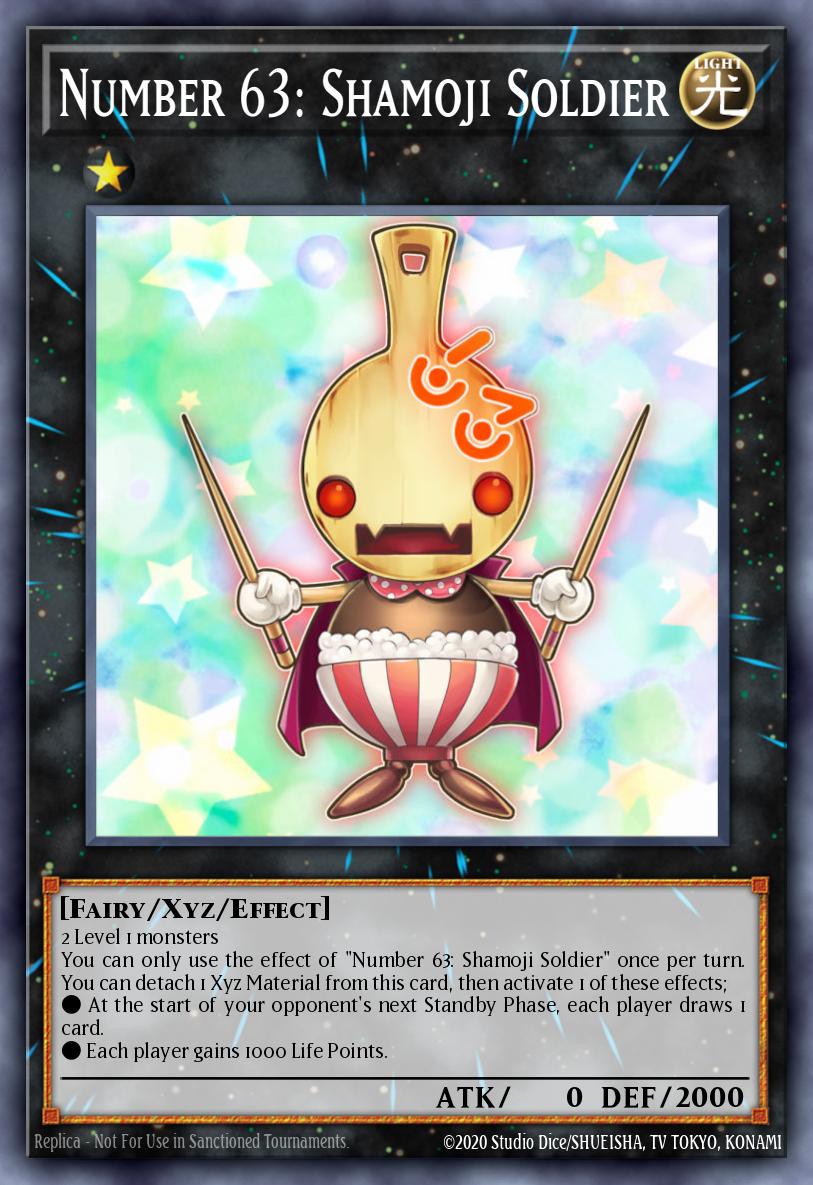
Number 63: Shamoji Soldier
ATK:
0
DEF:
2000
View:
1193
2 Level 1 monsters You can only use the effect of "Number 63: Shamoji Soldier" once per turn. You can detach 1 Xyz Material from this card, then activate 1 of these effects; ● At the start of your opponent's next Standby Phase, each player draws 1 card. ● Each player gains 1000 Life Points.

Number 63: Shamoji Soldier — Power Evaluation
Final Score: 39 ± 8 · Confidence: Medium
- Intrinsic: 43 · Deck: 39 · Meta: provisional
- Primary role: Utility · Secondary: Material body
Why it scores here
Shamoji Soldier is a generic Rank 1 XYZ accessible across 34 distinct archetypes, making it a widely splashable filler piece. However, its 0 ATK, symmetric draw effect (both players draw), and symmetric LP gain (both gain 1000) provide zero card or resource advantage. The complete absence from any recorded combo boards despite appearing in 107 decks confirms it functions as a utility tech, not a synergistic engine component. It contributes only a 2000 DEF wall that can consume materials for marginal, non-advancing effects.
Axis scores
| Axis | Score | Evidence |
|---|---|---|
| Accessibility | 45 | Runs in 107 decks across 34 distinct archetypes with 1.11 average copies, but requires 2 Level 1 monsters to summon; material cost creates genuine summoning friction despite broad archetype spread (observed) |
| Combo & Conversion | 15 | Zero appearances in any recorded combo board and 0 ATK means no contribution to end-board or combo chain; detached effects (1 delayed draw or 1000 LP each) are marginal and do not advance game state (verified) |
| Resource Economy | 30 | Summoning costs 2 Level 1 materials, activation consumes 1 XYZ material, and returns either symmetric card draw (opponent draws too) or symmetric LP; no net card advantage generated (observed) |
| Effect & Interaction | 5 | Draw effect is symmetric (both players draw 1); LP effect is symmetric (both gain 1000); no negation, removal, disruption, or opponent-facing interaction of any kind (verified) |
| Material Utility | 40 | 2000 DEF provides usable defensive body and Rank 1 XYZ offers material flexibility, but 0 ATK and lack of Tuner or special properties limit applicability beyond generic XYZ summons (observed) |
| Resilience & Flexibility | 35 | Card sits as consumable resource on field; 99 of 107 decks run exactly 1 copy indicating non-redundant tech rather than core line; no recovery, protection, or multi-turn utility; dead once materials exhausted (observed) |
| Deck-Building Efficiency | 50 | Light deck cost (average 1.11 copies, typically 1) and broad generic splash across 34 archetypes indicate clean efficiency; Level 1 material requirement is manageable for decks with natural Level 1 sources (observed) |
Calculation
Weight profile: Utility (default, no primary role blend). Intrinsic ≈ 43, Deck ≈ 39, Meta = provisional. Modifiers: Symmetric effects (no advantage) (-2). Final formula: 0.40*Intrinsic + 0.60*Deck
Strengths
- Widely accessible across 34 distinct archetypes without archetype lock
- Generic Rank 1 XYZ summon mechanics enable broad deck splice
- Solid 2000 DEF for defensive board contribution
- Light deck cost (1 copy standard) minimizes garnet risk and deck dilution
Weaknesses
- 0 ATK provides zero offensive presence; passive defensive only
- Draw effect is delayed one turn and symmetric, generating no card advantage
- LP gain effect is symmetric, providing no resource lead versus opponent
- Requires 2 Level 1 monsters; material cost to activate consumes resources
- Zero combo board appearances across all recorded boards confirms filler status, not synergistic engine
Best use
Rank 1 XYZ filler body; defensive tech with optional marginal utility activation. Decks: SPYRAL, Mitsurugi, Fiendsmith, Solfachord, Floowandereeze, War Rock. Suggested copies: 1.
Evidence & gaps
- Verified: Card text complete: 0 ATK / 2000 DEF Rank 1 XYZ; once-per-turn detach to choose draw-trigger or LP-gain; Appears in 107 decks across 34 distinct archetypes with no archetype lock; Zero appearances in any recorded combo board across all combo evidence; Top partners are all format staples (hand traps, board wipes), not archetype-specific cards
- Observed: Average 1.11 copies per deck; 99 of 107 decks run exactly 1 copy (non-redundant tech pattern); Gameplay split: 47.7% control, 43.9% combo (hybrid/control homes), suggesting filler rather than combo enabler; Broad 34-archetype spread indicates generic utility splice, not deck-specific power
- Inferred: Rank 1 XYZ requires 2 Level 1 materials to summon (standard XYZ mechanics); no explicit searcher mentioned in partner list; Filler utility piece: high deck frequency (accessibility) + zero combos (no synergy) = generic tech; Symmetric draw and LP effects mean zero card or resource advantage against opponent (neutral tempo only); Single-copy standard suggests optional tech inclusion rather than core engine redundancy
- Data gaps: No combos supplied — combo conversion is text-only inference; zero combo appearances means no empirical evidence of combo utility No guides supplied — no human strategy documentation on intended role or activation patterns No usage statistics (StatisticsCard) — archetype inclusion and typical copies inferred from 107-deck sample only; may not represent broader historical trends No complex interaction rulings — draw effect timing (opponent's next Standby Phase) is clear but interactions with phase skip/clock effects not explored